An Introduction by Elizabeth Shown Mills, CG, CGL, FASG, FNGS, FUGA

An Introduction by Elizabeth Shown Mills, CG, CGL, FASG, FNGS, FUGA
The 1802 presidential election ignited a controversy commonly attached to men of power across the ages. Thomas Jefferson, a wealthy Virginian running for the highest office of the new United States, was accused of fathering children by a mistress—a woman of color whom he personally enslaved. Across two centuries since, this charge has been framed as a character issue of national consequence. On the one hand, Jefferson’s reputed relationship with Sally Hemings has symbolized the evils of slavery and, more broadly, the limited agency that women, historically, have had over their own lives and bodies. On the other hand, the perceived attack on Jefferson’s personal virtue has been treated as, fundamentally, an attack on America’s bulwarks.
That polarized argument stood, unresolved, until the turn of the twenty-first century. Scientist Eugene A. Foster, in the late 1990s, recognized the extent to which genetic advancements could be used to resolve historical questions. Testing five living males who carried a Y-line from Jefferson’s brother Field against the one known male-line descendant of Jefferson’s putative sons, Foster published a historical grenade in 1998: offspring of Sally’s son Easton Hemings carried the Jefferson Y.
In response to that finding, Jefferson loyalists reframed their defense of Thomas. A newly formed “commission of scholars” issued a rebuttal in early 2001, reinterpreting Foster’s findings as evidence that a mentally erratic Field Jefferson succumbed to the seductions of Sally Hemings. However, that commission—composed of attorneys, biochemists, economists, librarians, and presidential historians—had one significant flaw. As the genealogical scholar Dr. Thomas W. Jones soon pointed out: “Whether Person X is the parent of Person Y—when both are deceased—inherently is a genealogical question.” Yet, no genealogical scholar sat on that commission. No member held expertise in issues of family, gender, or race. Worse, the research standards and methods that underlay their final opinion did in no way represent the stringent standards and methods of modern genealogy.
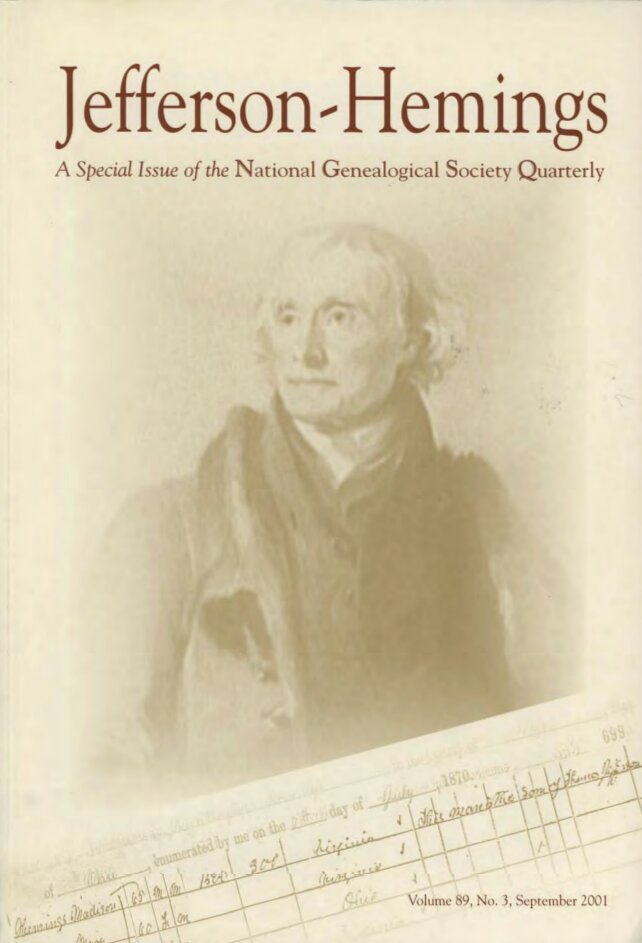
As then-editor of the National Genealogical Society Quarterly, I sought to fill that void—commissioning an independent panel of genealogical scholars with deep experience in the relevant research areas. The September 2001 special issue, Jefferson-Hemings, presented their investigations, their correlation of the evidence, and their conclusions. Their independent analyses left no room for doubt. When rigorous genealogical standards are applied to this historical question, all evidence supports the assertion publicly made by Sally Heming’s son Madison in 1873: Thomas Jefferson was his father and the father of all children his mother bore.
New DNA evidence now developed by the Smithsonian Institution confirms the conclusion that the NGSQ panel reached in 2001. The discovery of a lock of Jefferson’s own hair at the Smithsonian enabled a full sequencing of his genome. When analyzed against that of newly-tested descendants of Sally Hemings, the autosomal DNA—like the Y-DNA and the documentary evidence—enables a sound genealogical reconstruction of the family produced by Thomas Jefferson and his late-wife’s enslaved half-sister, Sally Hemings.
To support these new DNA findings, the National Genealogical Society is pleased to make its 2001 special issue, Jefferson-Hemings, openly available to all scholars, students of history, genealogists, and others who seek a better understanding of both genealogical standards and the historical fabric of America’s racial issues.
– Elizabeth Shown Mills, November 2026
Uploading NGS-authored or NGS‑licensed content—such as articles, research papers, blog postings, databases, indexes, and print book or print journal or newsletter excerpts—into AI tools is not permitted because it may expose that material to the AI system for potential model training. As the publisher for all NGS authorized content, NGS prohibits sharing, uploading or distributing said content to outside platforms, including AI systems. Violating these terms can not only violate US copyright law, whether infringing content authors’ copyright rights or NGS’s rights in composite works, but also jeopardize NGS members from accessing valuable NGS content and programs.
Any digital or hardcopy content that falls under NGS intellectual property should not be uploaded to any AI tool, without the prior written consent of NGS.